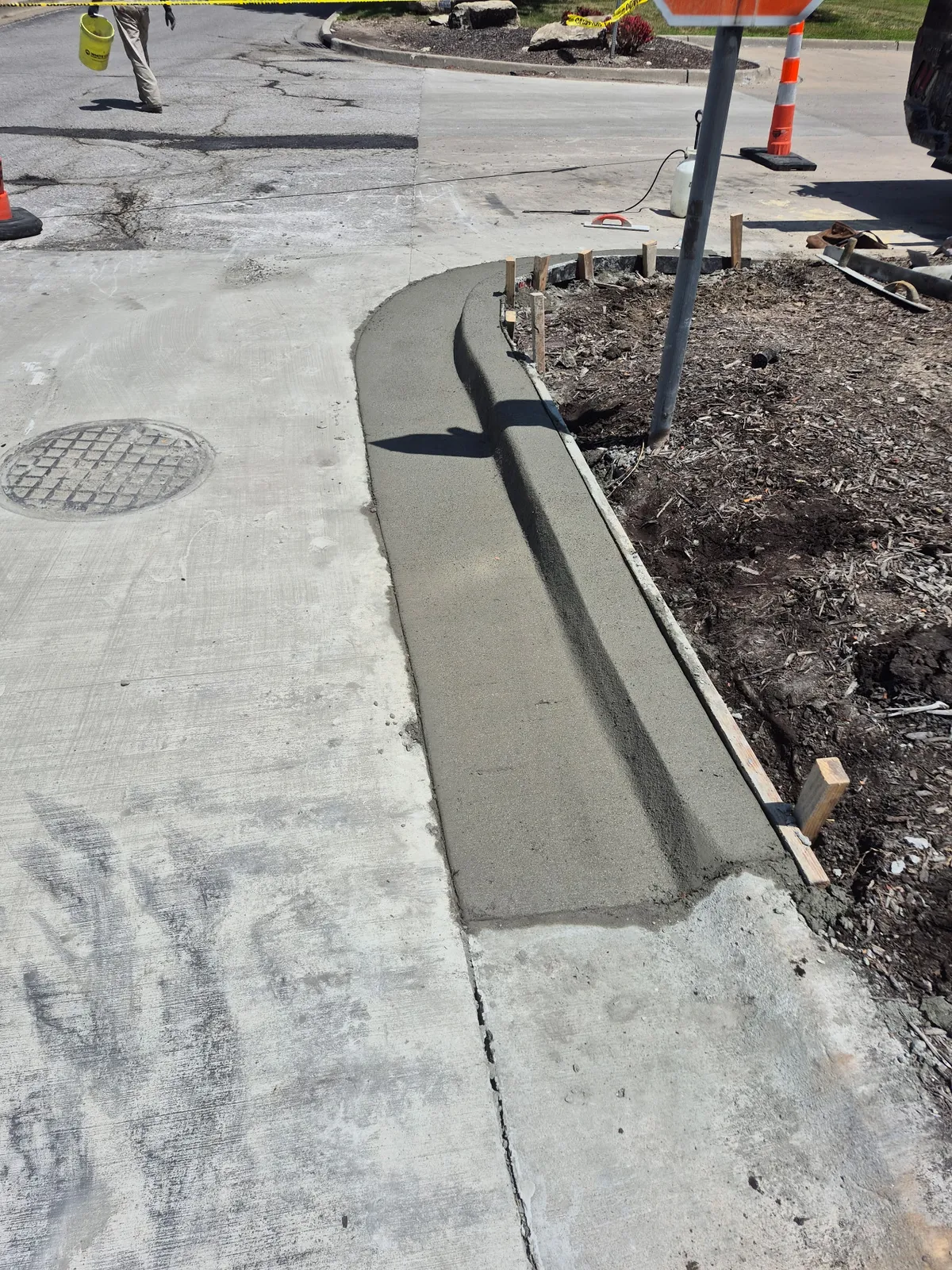
Curb and Gutter Installation in Kansas City — Extruded and Formed
Commercial concrete curbing that manages drainage and protects your pavement investment.
Get your free Curbs & Gutters estimate
Tell us about your property and we'll take a look — you'll hear back within 24 hours, or call (913) 701-6044 now.
- Free estimate, no obligation
- Response within 24 hours
- 1-year warranty on all work
- Owner-led — no subcontractors
What Makes Commercial Curb and Gutter Systems Different from Residential
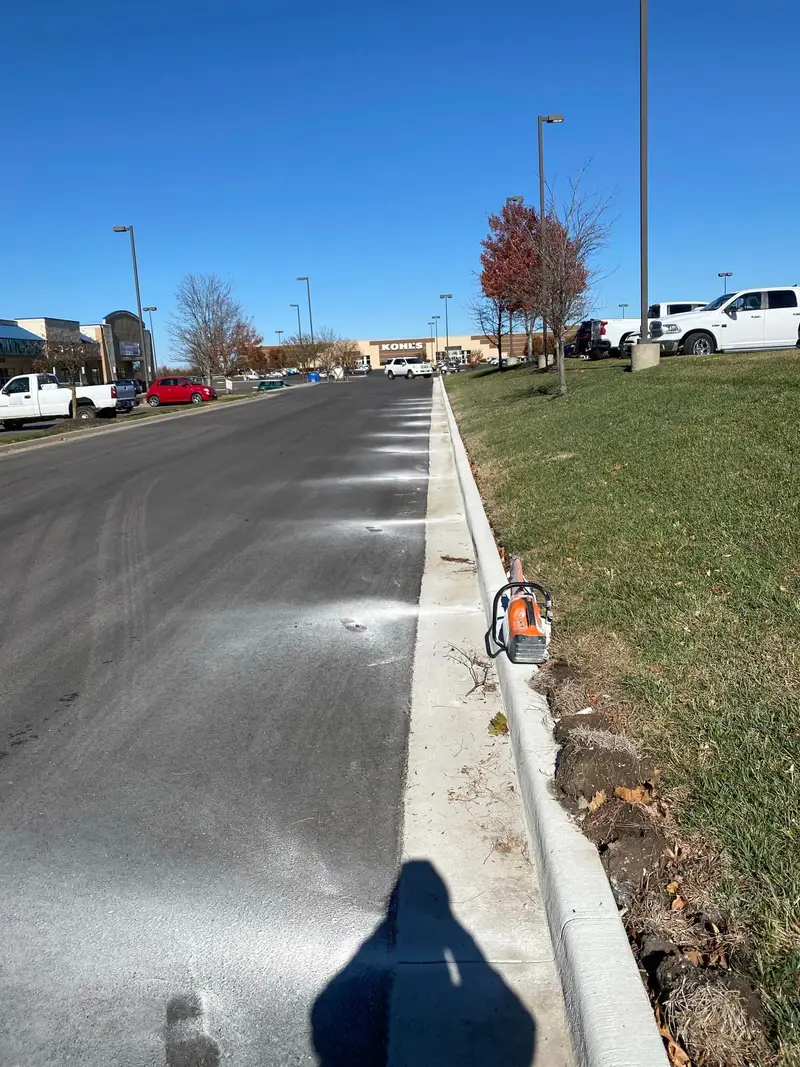
Commercial properties demand curb-and-gutter systems engineered to handle massive water volumes and constant vehicle traffic. Your retail center or office complex needs barrier curb heights of 6-8 inches with proper curb reveal height to direct runoff into catch basin throats. We install Type M concrete mix (4,000 PSI minimum) using slip-form curbing machines that create continuous, jointless runs up to 500 feet. The difference shows in longevity – commercial curbs endure 18-wheelers mounting them daily, snow plows scraping them 20+ times each winter, and channeling thousands of gallons during Kansas City's intense summer storms. Our extruded curb process ensures consistent dimensions critical for ADA compliance at every curb cut and transition. With Jackson County's notorious clay soils, we excavate 12-18 inches deep and install compacted AB-3 aggregate base to prevent the settling that plagues lesser installations.
How Long Should Concrete Curbs Last in Kansas City's Freeze-thaw Climate
Properly installed commercial curbing survives 30-40 years despite our metro's 100+ annual freeze-thaw cycles. The key is starting with 4,500 PSI air-entrained concrete containing 5-7% microscopic air bubbles that allow expansion without cracking. We pour when temperatures stay above 40°F for 24 hours and apply curing compound immediately to slow moisture loss. Valley gutter sections need extra attention – we thicken them to 8 inches and add fiber mesh reinforcement where water concentrates. Every 20 feet, we cut control joints within 12 hours of pouring to manage the inevitable concrete shrinkage. Poor installations fail within 5-10 years when contractors skip the aggregate base or pour standard 3,000 PSI residential mix. Our crews have replaced countless parking lots where original curbs crumbled because someone saved $2 per linear foot on materials. Joe Brogoto personally verifies our mix designs match the engineered specifications before every pour.
When to Schedule Curb Repairs Versus Full Replacement
Minor cracks under 1/4 inch wide and isolated spalling sections smaller than 12 inches typically warrant repairs using polymer-modified patching compounds. But when you see vertical displacement exceeding 1/2 inch, multiple cracks per 10-foot section, or deterioration affecting more than 20% of your curb line, replacement becomes more cost-effective. Drainage swale erosion beneath curbs signals immediate attention – water undermining the base accelerates failure exponentially. We assess each property individually, but generally recommend phased replacement for properties over 15 years old. Start with high-traffic areas near entrances and loading zones where rollover curb sections take the most abuse. Smart managers budget curb work alongside seal coating cycles every 3-5 years. Waiting until complete failure forces emergency repairs at premium rates and risks ADA lawsuits from trip hazards. Our 30-person crew can replace 1,000 linear feet of curbing over a weekend to minimize business disruption.
Critical Commercial Applications for Professional Curb Systems
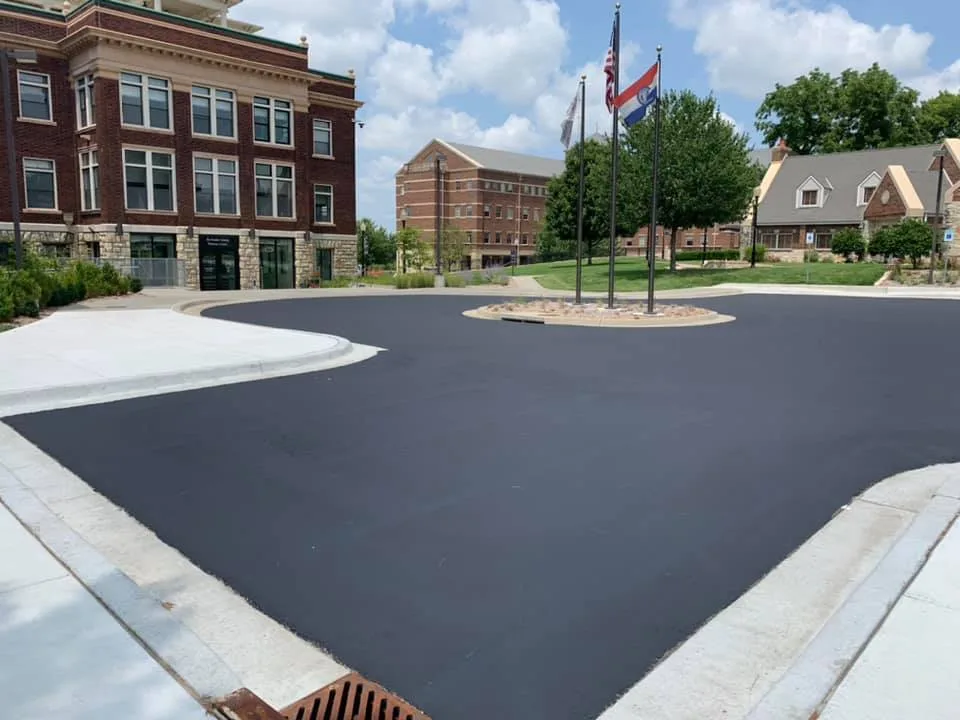
Distribution centers require reinforced rollover curb designs at every dock approach to withstand daily semi-truck traffic while maintaining positive drainage away from loading areas. Medical facilities need precise valley gutter installation to prevent standing water near patient drop-offs and emergency entrances. Retail shopping centers demand continuous barrier curb protection for pedestrian walkways plus strategically placed curb cuts meeting exact ADA slope requirements. Industrial facilities often specify extruded curb machine installation for chemical-resistant concrete around fueling stations and equipment wash bays. Multi-family complexes benefit from decorative stamped curbing that defines landscaped areas while channeling stormwater to detention basins. Each application requires different concrete mixes, reinforcement strategies, and drainage calculations based on impervious surface ratios and local stormwater regulations.
Need Curbs & Gutters for Your Property?
Get a free estimate from the crew that has completed 4,000+ projects across the KC metro. No pressure, no obligation.
Setting Forms and Pouring Curbs That Handle Commercial Traffic
What happens after you call your Kansas City paving contractor — from first inspection to final walkthrough.
We inspect your lot, identify every issue, and provide a detailed estimate — no cost, no pressure.
We design the scope of work around your business hours so your operations aren't disrupted.
Old asphalt is milled down, debris cleared, and the base is prepared for a clean bond.
Fresh hot-mix asphalt is laid to spec and rolled to precise compaction with commercial-grade equipment.
Parking spaces, fire lanes, ADA markings, and signage — your lot is fully compliant and looks brand new.
We walk the finished project with you. If anything isn't right, we make it right before we leave.
Signs Your Property Needs Curbs & Gutters
Pooling Water
Standing water within 10 feet of curb lines indicates failed drainage slope or settled sections.
Visible Cracks
Multiple cracks per section or gaps exceeding 1/4 inch signal structural failure requiring replacement.
Curb Displacement
Shifted or tilted sections create trip hazards and violate ADA compliance requirements.
Pavement Edge Damage
Crumbling asphalt along curb lines shows water infiltration undermining the pavement structure.
Variables That Affect Commercial Curb and Gutter Pricing
Linear footage drives base costs, but site conditions create the real variables. Removing existing deteriorated curbs adds disposal fees and labor hours, especially with steel-reinforced sections requiring saw cutting. Subgrade conditions dramatically impact pricing – stable limestone base costs far less than excavating Jackson County clay and importing engineered fill. Curb profile complexity matters too. Standard barrier curb runs efficiently with slip-form equipment, while radius curves and special reveal heights require hand-forming. Access restrictions on tight urban sites may necessitate smaller machines or manual placement, increasing labor costs. Project timing affects material pricing since concrete plants charge winter premiums November through March. Special additives like accelerators for cold-weather pours or colored concrete for architectural requirements add incremental costs. Properties requiring maintained traffic patterns need phased construction and temporary ramping, extending project duration.
Get a Free Estimate — (913) 701-6044Recent Curbs & Gutters Projects
Curbs & Gutters — Frequently Asked Questions
How quickly can you complete curb replacement for my 50,000 square foot parking lot?
A typical 50,000 square foot commercial lot contains 800-1,200 linear feet of curbing. Our 30-person crew completes 400-500 linear feet daily using slip-form curbing equipment. Plan for 2-3 days of active construction plus 7 days curing time before heavy vehicles can mount the new curbs. We often phase the work in sections to maintain customer access. Demolition and base preparation add another 1-2 days upfront. Weather permitting, the entire project from start to striping touch-ups takes 10-14 calendar days.
What's the difference between barrier curb and rollover curb for commercial properties?
Barrier curb stands 6-8 inches tall with a vertical face designed to prevent vehicles from leaving the pavement. Install these along sidewalks, landscape islands, and property perimeters for maximum protection. Rollover curb features a sloped face allowing vehicles to mount it when necessary. These work best at loading dock approaches, emergency access routes, and temporary overflow parking areas. Most commercial properties need both types strategically placed. We recommend barrier curb for 80% of your perimeter with rollover sections only where operational needs require vehicle crossing. The concrete mix and reinforcement remain identical – only the formed profile changes.
Can you match existing curb heights when doing partial replacements?
Absolutely. We measure curb reveal height every 25 feet along existing sections to ensure flush transitions. Standard commercial curbs run 6 inches above pavement with 6-inch depth below grade, but older properties vary widely. Our crews use laser levels to document existing elevations before demolition. During installation, we adjust our slip-form machines or hand-forming templates to match within 1/8 inch tolerance. This precision prevents drainage problems where new sections meet old. For properties with multiple curb profiles, we create transition pieces that gradually adjust height over 10-foot runs to eliminate abrupt changes.
How do catch basins integrate with new curb and gutter systems?
Catch basins require precise coordination between curb elevation and throat opening dimensions. We position basin throats 1/2 inch below the gutter flow line to capture runoff without creating turbulence. Standard commercial installations space basins every 250-300 feet along continuous runs, with additional units at low points. The curb face gets notched to create a 2-foot wide opening reinforced with steel angles. Valley gutter sections slope 1/4 inch per foot minimum toward each basin. For heavy flow areas, we install 3-foot throat openings with steel grates rated for H-20 loading. Poor basin integration causes premature pavement failure from trapped water.
What maintenance extends commercial curb life in Kansas City weather?
Annual inspection catches problems early. Look for cracks exceeding 1/8 inch, spalling concrete, and vegetation growing in joints. Seal cracks immediately using polyurethane sealant rated for concrete movement. Clean valley gutters every spring and fall to prevent debris dams that pool water against curb faces. Apply penetrating concrete sealer every 5 years to reduce moisture infiltration during freeze-thaw cycles. Keep snow removal equipment operators aware of curb locations to prevent plow damage. Remove ice melt residue each spring since chlorides accelerate concrete deterioration. When landscape irrigation overshoots onto curbs, adjust sprinkler heads immediately. These simple steps add 10-15 years to curb life.
Trusted Across the KC Metro
Ready to move forward?
One crew installs it, maintains it, and keeps it compliant — no subcontractors. Call (913) 701-6044 or send the form.
KC Metro Cities Where We Provide Curbs & Gutters
Curbs & Gutters — One Call Handles It
One call handles it all — from the first estimate to the final walkthrough. Platinum Paving has completed 4,000+ projects across the KC metro. Every job comes with our 1-year warranty.